
Reading
Learning the fundamentals of reading and writing is a cornerstone of first grade. From reading the morning message to personalized reading folders, first graders at EHS read throughout their day. Phonics instruction continues through the Wilson Fundations program; students learn to decode and encode consonant and vowel blends and spell high frequency words. First grade also uses the Heggerty Curriculum to build phonemic awareness. A critical component of our program is reading groups, where students receive small group instruction in decoding, fluency, and comprehension. Students delve deeper into story plots and begin to make text-to-self and text-to-text connections. A unique aspect of the first grade reading program is Roving Readers. During this special time every week, each first grader travels through the halls of the school to sit down with an administrator who is waiting to hear that child read. Each year, the students learn how to navigate nonfiction texts when completing science research projects.
Writing
To explore the writing process, students write everything from creative stories to informative works, all while practicing their handwriting skills. First grade students identify nouns and learn the components of a complete sentence, being sure to include a subject in each sentence. They also generate writing in which the development and organization are appropriate to the task, purpose, and audience. They are introduced to the seven traits of the writing process: ideas, organization, voice, word choice, sentence fluency, conventions, and presentation. They also learn the proper format to write a friendly letter. One of the highlights of first grade writing is the Monday Slice, a journal entry that children compose at the beginning of each week.
We use the Illustrative Mathematics (IM) curriculum for first grade math.
The big ideas in Grade 1 math include: developing understanding of addition, subtraction, and strategies for addition and subtraction within 20; developing understanding of whole-number relationships and place value, including grouping in tens and ones; developing understanding of linear measurement and measuring lengths as iterating length units; and reasoning about attributes of, and composing and decomposing geometric shapes. ~Illustrative Mathematics
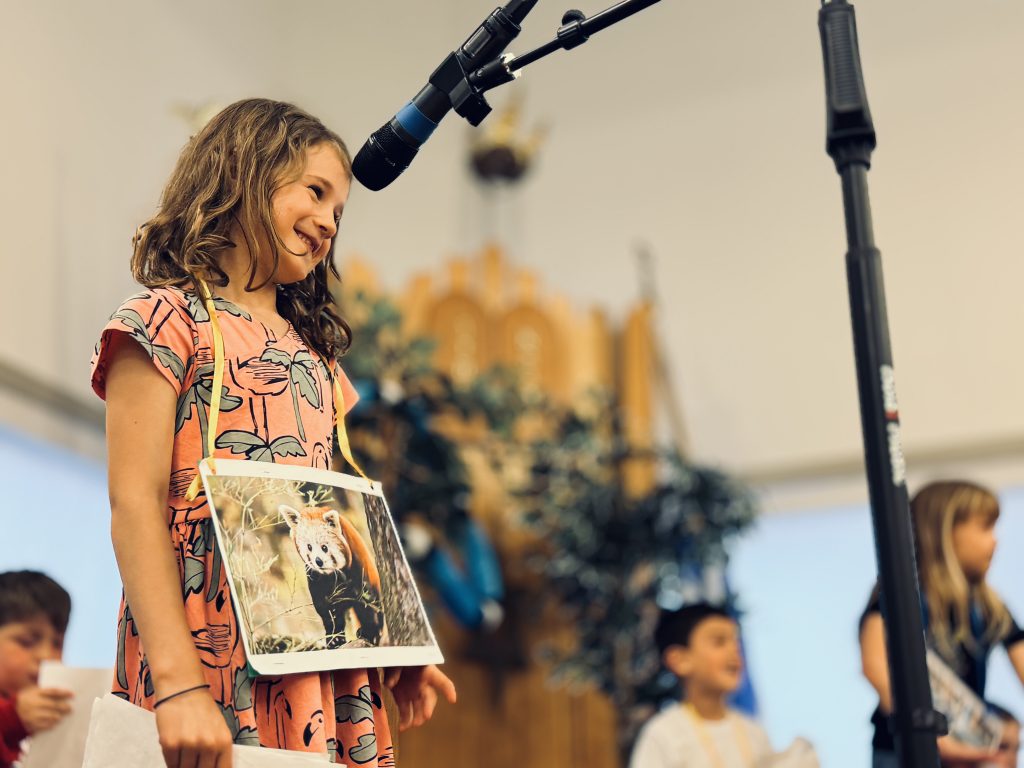
Our first grade science curriculum provides students with the opportunity to participate in many hands-on experiments. Every child identifies as a scientist as they learn to use their science journal and utilize all their senses. Children delight in learning about weather systems in the fall, observing the changing of seasons and building their own weather tools. Students also complete a unit on magnets where they explore invisible forces in action through experimenting with attraction and repulsion. In the spring, first graders learn about the five major biomes in our world. Students learn about the unique characteristics of each biome and how animals within each biome adapt for survival. Using a variety of plants and vegetation, we build models of each biome we study, and the students complete individual research projects on a particular animal and its adaptations. Finally, the children perform in an engaging musical that showcases their learning. The play and projects are often a highlight of first grade.
Our social studies work centers around town communities. First graders look at the roles of town members and consider the qualities that make a good community member, identifying those qualities in themselves and their classmates. Students consider these duties and qualities when they build their own city and choose important people and places to include. They also learn how maps provide direction and use their mapping skills when determining the design of their imaginary city. First graders also learn the basics of economics, including how to discern between wants and needs, goods and services, and how people make and spend money. This unit teaches children to continue thinking about how they relate to their community and culminates in the children running a shuk (market) at the school. Through play, students conceptualize these ideas as they create a strong community together.
Hebrew
Beginning in first grade, the iTalAm curriculum is used to teach reading and writing in Hebrew. Students learn through stories, music, workbooks, and interactive SmartBoard activities. Teaching is also supplemented with Israeli children’s books, and the students are encouraged to write simple stories based on these mentor texts. In first grade, students continue to write in block lettering, and they are introduced to Hebrew vowels. Some units of study include food, weather, and animals.
Jewish Studies
Torah: Stories are told in Hebrew using Godly Play, role playing, and puppets. The children create their own Torah book (parasha) in Hebrew with their favorite parts from the narrative. Selections from this book are read as a part of a year end program.
Holidays: We learn about the holidays through the iTalAm curriculum which includes vocabulary, a workbook, stories, and songs for each holiday. Students learn the history, symbols, and traditions associated with each holiday and experience them in school through different mitzvot. Students also create handmade projects coinciding with their holiday studies.
Israel: Students develop a meaningful relationship with Israel through personal connections with language, people, places, and events. As an ancient land and modern state, we teach our students that Israel is a home for diverse and vibrant expressions of Judaism. Our students engage with Israel at all grade levels and feel a deep connection to their homeland.
Prayer: Students continue to learn the meanings of prayers from the morning service and create their own prayer books which include personal interpretations of the prayers. At the end of the year, the children have a special ceremony where they showcase their handmade prayer books and receive their own personal prayer book.
The goal of our music program is for students to become skillful and enthusiastic music makers through music literacy, participation and performance. Through joyful discovery of classical and contemporary music, students cultivate musicality and knowledge. First grade students continue learning to sing in-tune with expression while gaining confidence on stage. Additionally, first graders begin learning to read music and play several instruments including xylophones, bells, and other percussion instruments.
Students work with a variety of drawing tools, paints, and papers. Students learn techniques for drawing, painting, weaving, printmaking, and collage. In first grade, students expand on their knowledge of elements of art such as line, shape, color, and texture. Emphasis is put on the creative process rather than the finished product. Throughout the year, art is integrated with units of study in the classroom, as art helps children use visual content to understand subjects more clearly.
In first grade, students begin the year learning how to express emotions using facial expressions, gestures, and body language. Students demonstrate these abilities by taking turns acting out stories and creating mini-scenes of their own about everyday situations. When preparing for the “Biome play,” the culmination of their study of the world’s biomes in science, students gain experience working in an ensemble as well as taking personal responsibility for their own individual parts. half of the year, students work towards a musical performance, practicing established skills while developing new ones. Students also gain experience working in an ensemble as well as taking personal responsibility for their own individual parts.
In physical education class, students are encouraged to participate in low- and high-energy activities with a focus on physical coordination, sportsmanship, and problem solving. Students learn the fundamentals and rules of major sports, as well as physical fitness, stretching, and agility. Units over the school year include soccer, flag football, basketball, handball, strategy games, and floor hockey. Using demonstration of skills, review of age appropriate rules and scrimmages, students learn new sports, the importance of physical fitness, respectful play with others, and how to engage in healthy competition.
Students continue to explore fiction/nonfiction and genres/formats. In coordination with their animal projects, they learn about different elements of a nonfiction text such as table of contents, index, and glossary. During weekly read-alouds, students dive into trickster tales and pourquoi tales while continuing to develop their critical thinking skills by relating to stories and asking questions.