
Reading
Phonics instruction through Wilson Fundations and Heggerty Phonemic Awareness continues in second grade. When reading literature, students continue learning the skills of plot analysis as they answer the questions “Who?”, “What?”, “Where?”, “When?”, “Why?, and “How?” They study how characters change and develop in a story and infer meaning within a text by determining the theme and moral of the story. Students also read nonfiction books and learn how to navigate these texts using table of contents, indexes, and glossaries. They integrate and apply these skills when researching influential Americans in social studies: identifying main ideas, sequencing events in chronological order, and summarizing details.
Writing
In second grade, students continue to learn how to utilize the traits of ideas, organization, voice, word choice, sentence fluency, conventions, and presentation in order to improve their narrative and creative writing. Students do pre-writing activities to brainstorm and then use graphic organizers to organize their thoughts on paper. Students write rough drafts and learn how to improve their writing through revisions. The process culminates with the students “publishing” a final copy of their writing. In grammar studies, students are learning to identify action verbs and adjectives; learning parts of speech helps students utilize the English language in ways that will improve both their speaking and their writing. In spelling, second grade students learn to spell multisyllabic words and use common prefixes and suffixes to change the meaning of known words.
We use the Illustrative Mathematics (IM) curriculum for second grade math.
The big ideas in IM Grade 2 include: extending understanding of the base-ten number system; building fluency with addition and subtraction; using standard units of measure; and describing and analyzing shapes. ~Illustrative Mathematics
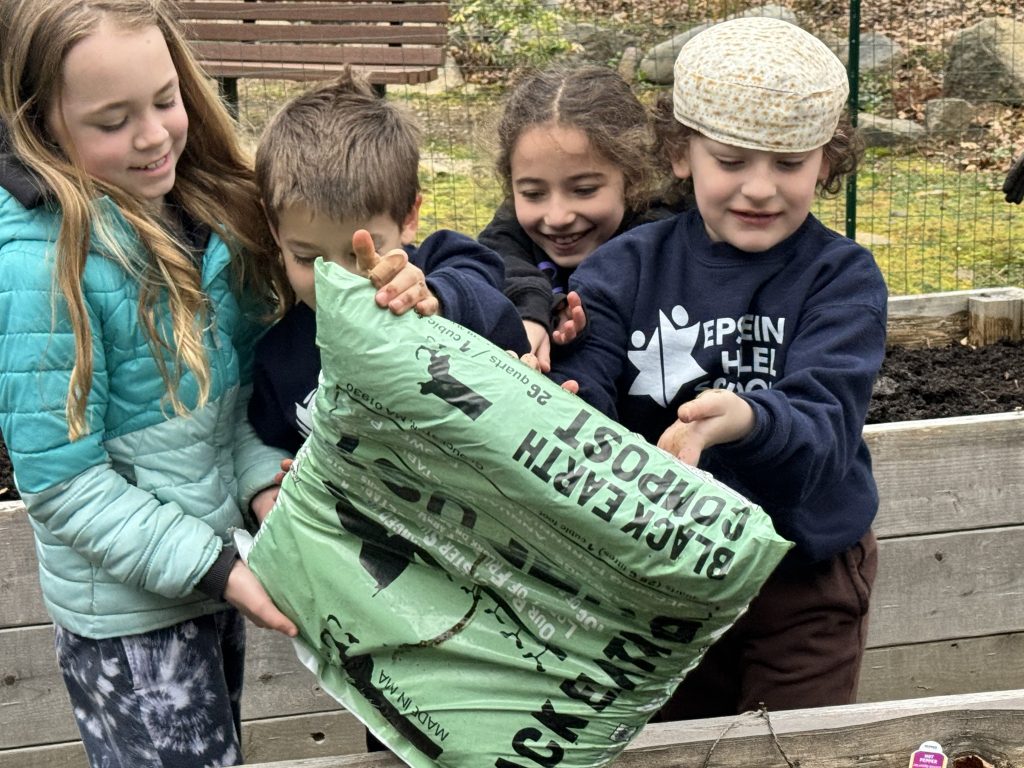
The first science unit in second grade is the life cycle of seeds and plants. Throughout this unit, students compare and contrast seeds, observe seed germination, examine plant parts, and conduct experiments. The study of plants is enhanced by the school’s outdoor garden, where students are able to take part in the planting and harvesting of crops and see the cycle from seed to produce firsthand. Also as part of the life cycle unit, chrysalises are brought into the classroom, and students observe and document the metamorphosis of a caterpillar into a monarch butterfly. The next unit focuses on the physics of simple machines. Topics include: force, gravity, friction, and motion. Students explore how using simple machines such as levers, pulleys, wheels and axles, inclined planes, and wedges reduce the amount of force required to do work. Second grade students also study the sun and moon. The students identify the sun as a source of light, heat, and energy needed for life, and they record observations of the phases of the moon. Throughout the year, students learn coding skills using LEGO Robotics, Kodable, and Scratch Jr.
Second grade social studies begins with a study of the regions of the United States. The unit starts with a focus on map-reading skills; students learn to identify and label different parts of the map, including the compass rose, key, and scale. They then work on identifying the regions of the United States, labeling all 50 states on a map, and locating the capital city in each state. Students learn about the landforms, resources, climate, and landmarks of each region. Second grade students then independently research an influential American, researching using nonfiction texts to learn about their childhood, education, motivation, and contributions to our society. Students combine their research notes into a biography that is presented in front of classmates and families at the “Biography Blast.” At the end of the year, students take a learning journey to the other side of the globe to study geography and culture of Japan. They are able to use what they have previously learned to compare and contrast the culture of Japan with that of the United States.
Hebrew
In second grade Hebrew, students acquire new tools for becoming more independent learners in both reading and writing. Students continue to work on reading fluency, and they learn to write Hebrew letters in script. Using the iTalAm curriculum, students learn new vocabulary and grammar; they practice identifying nouns, present tense action verbs, and adjectives in different forms, including masculine, feminine, singular, and plural. Students are also encouraged to speak conversationally as a part of each lesson. Second grade students are introduced to short stories while they continue working on reading comprehension and written expression.
Jewish Studies
Torah: Second grade students begin learning Torah in Biblical Hebrew. They study the days of creation in the first chapter of the book of Genesis and are encouraged to connect their knowledge of the natural world with the biblical narratives to explore God’s relationship to the world in the Torah. They learn skills that enable them to become comfortable navigating, reading, and understanding the Torah in Biblical Hebrew.
Holidays: Second grade students learn about holidays (symbols, history, and traditions) and experience them in school through different mitzvot. Students learn the Hebrew names of the different ritual objects, the specific blessing said over each object, and what they symbolize.
Israel: Students develop a meaningful relationship with Israel through personal connections with language, people, places, and events. As an ancient land and modern state, we teach our students that Israel is a home for diverse and vibrant expressions of Judaism. Our students engage with Israel at all grade levels and feel a deep connection to their homeland.
Prayer: Second grade students learn the daily morning blessings called Birkot Hashachar (blessings of the dawn). Throughout the year, students focus on reading prayers with fluency and accuracy as well as intentionality.
The goal of our music program is for students to become skillful and enthusiastic music makers by encouraging music literacy, participation, and performance. Through joyful discovery of classical and contemporary music, students cultivate musicality and knowledge. In second grade, students continue learning to read music and play several instruments including the xylophone.
Students work with a variety of drawing tools, paints, and papers. Students learn techniques for drawing, painting, weaving, printmaking, and collage. Second grade students expand their knowledge of the elements of art such as line, shape, color, and texture, and as their fine motor skills continue to develop, the students become more adept at utilizing these elements in their artwork. Emphasis is put on the creative process rather than the finished product. Art is also integrated with units of study in the classroom throughout the year, since visual content helps children understand subjects more clearly.
In second grade students expand upon what they’ve learned in the past year by breaking stories down and working in groups to perform the beginning, middle, and end of stories. Students demonstrate their understanding of emotions by using their bodies to show how they feel and by using emotions to talk about characters. These skills are utilized when the second grade students act as historians and present biographies they have written on influential Americans during the second grade “Biography Blast.”
Students in second grade PE focus on self control during game play and demonstrating sportsmanship and cooperation. These skills are developed during a soccer unit where students practice movement and coordination through dribbling and passing the ball. Other games involving balls are also played to teach students about accuracy when throwing and catching a ball.
Students continue to develop their literary tastes as well as deepen their understanding of the library’s organization in preparation for their introduction to the online catalog. Second grade students learn how to use a dictionary and thesaurus, and in coordination with their biography projects, they become familiar with biography elements such as timelines. During weekly read-alouds, students dive into fables and biographies while continuing to develop their critical thinking skills by relating to stories and asking questions.