
Reading
In sixth grade language arts, students analyze a variety of literary genres. As they read, students identify the protagonists and antagonists of each novel and analyze their actions. They also consider the major themes and symbols in each piece of literature. Students’ vocabulary is enriched as they read and work to determine the meaning of unfamiliar words through context. Outside of the novels read together in class, students are also required to complete independent reading projects.
Writing
Using the Framing Your Thoughts program, grammar instruction is both explicitly taught and embedded in writing lessons. Instruction focuses on maintaining agreement between subject and predicate when writing complex and compound sentences and correctly identifying prepositions and their objects. Students effectively organize ideas within a written piece using a variety of transition words, phrases, and clauses to manage sequence. Additionally, students construct persuasive essays in which they support their claims with specific reasons and relevant evidence. Editing and revising continues to be an important focus of the writing process in sixth grade. Spelling is taught using the Words Their Way program. Students apply hands-on strategies of categorizing and sorting words to learn spelling patterns and vocabulary. They also study Latin and Greek roots.
We use the Illustrative Mathematics (IM) curriculum for fifth grade math. Topics in the sixth grade scope and sequence include an exploration of area and surface area, ratios and rates, multiplication and division of fractions and decimals, expressions and equations, rational numbers, and the examination of data sets and distributions. We use the Illustrative Mathematics (IM) curriculum for fifth grade math. Topics in the sixth grade scope and sequence include an exploration of area and surface area, ratios and rates, multiplication and division of fractions and decimals, expressions and equations, rational numbers, and the examination of data sets and distributions.
Science instruction takes place in the science lab where students are learning concepts through hands-on experiments and engagement. Students begin the year by learning how to properly use a compound microscope, identifying the parts of the microscope and explaining the function of each part. They learn to properly prepare dry mounts, wet mounts, and stains for microscope viewing. The next unit of study is cells, and students are able to use their skills with the microscope to view and describe the structure of different types of cells. Next, students learn about waves and energy, distinguishing between kinetic and potential energy and calculating each type of energy. The year ends with a unit on water conservation; the unit culminates with the students designing and testing a water filtration system. A special part of sixth grade science is also a three-day trip to Camp Burgess where students learn about nature in a hands-on setting, all while practicing teamwork and collaboration.
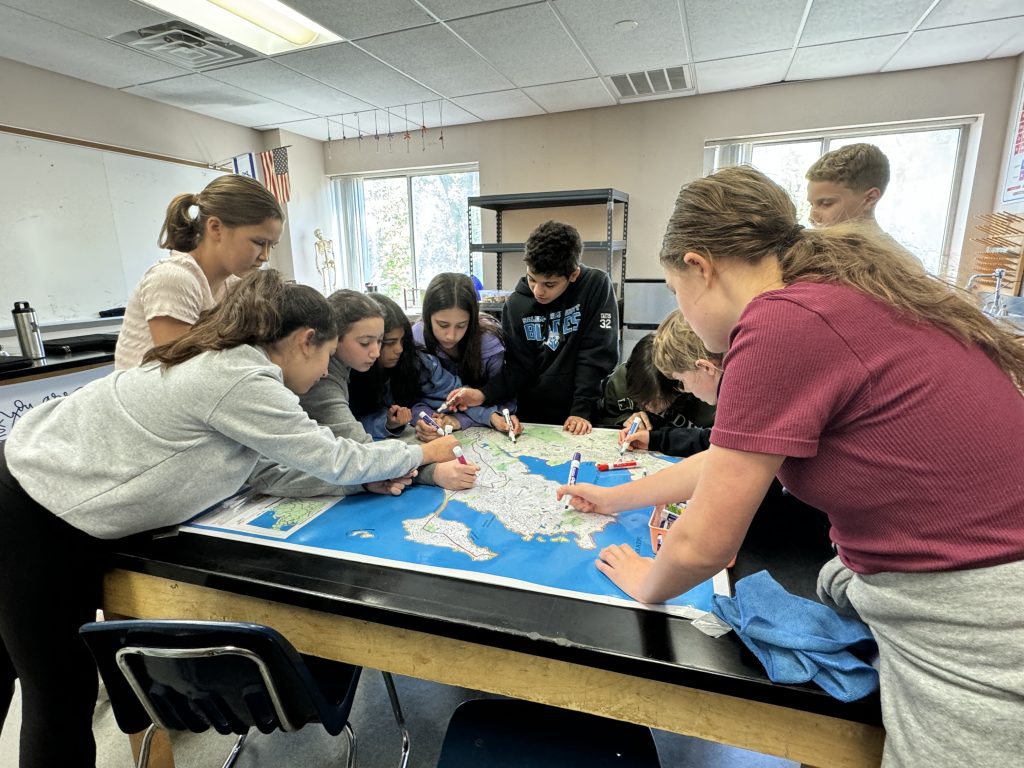
Sixth grade social studies begins with a study of European explorers to the New World in the fifteenth and sixteenth centuries. Students explore the motivations of the European explorers to travel to the Americas and learn about the interactions between the indigenous people and the explorers. Next is a unit of study on colonial America; the students learn about the founding beliefs, geography, culture, and economies of each of the thirteen original colonies. Students are able to partake in “living history” through a field trip to the Marblehead Museum and a walking tour of Old Town. Finally, sixth grade students study the American Revolution. Students analyze the events leading up to the start of the Revolutionary War, identify leaders and their roles in the American Revolution, outline major battles of the Revolutionary War, and analyze the Declaration of Independence for its historical significance. A field trip along the Freedom Trail in Boston brings the history of the American Revolution to life for the sixth grade. Throughout each unit of study, students read and interpret maps and analyze primary and secondary sources.
Hebrew
The iTalAm program provides videos and activities for students to learn more about Israeli culture and Hebrew vocabulary, reading comprehension, and grammar. Students in sixth grade Hebrew focus on being able to speak, write, and read using the present and past tense. Reading fluency is developed through varied texts such as short stories, poetry, and print media.
Jewish Studies
Torah: Students study biblical events from a historical context and follow the progress from biblical to ancient Israel. They explore many different themes such as family, leadership, and interpersonal relationships. Students learn how to navigate through the Tanach and find specific verses in English and Hebrew.
Holidays: In sixth grade Jewish studies, students deepen their understanding of Jewish holidays and their historical, natural/agricultural, and faith-based foundation. They learn how our customs and traditions enrich and strengthen them as individuals within our Jewish community. Prayers and blessings related to the holidays are learned and Hebrew stories connected to the Jewish holidays are studied.
Israel: Students develop a meaningful relationship with Israel through personal connections with language, people, places, and events. As an ancient land and modern state, we teach our students that Israel is a home for diverse and vibrant expressions of Judaism. Our students engage with Israel at all grade levels and feel a deep connection to their homeland.
Prayer: Students experience community prayer once a week. Music is used to enhance students’ spiritual experience connecting their hearts and minds. Students learn the keva (structure) of the Shacharit (morning prayer service) and explore pathways to deepen kavana (intentionality). Sixth grade students learn the Torah trope (notation system for chanting Torah), taught to them by a cantor from the community. This special study culminates in a Torah service in which the students read Torah for the first time in front of peers, teachers, and family. Students continue to participate in Torah services and discuss the weekly reading and other sacred texts.
The goal of our music program is for students to become skillful and enthusiastic music makers, encouraging music literacy, participation, and performance. Through classical and contemporary music, students learn to sing in-tune with expression and confidence while gaining confidence on stage. Sixth grade students continue to play the keyboard, furthering their abilities to read music and play increasingly difficult chord progressions.
Students work with a variety of drawing tools, paints, and papers in sophisticated ways. Students learn techniques for drawing, painting, printmaking, and collage. Within each grade level, elements of art such as line, shape, form, color, texture, value, and space are taught. Emphasis is put on the creative process rather than the finished product. Art history is an important component of our curriculum; students study different artists and art movements from the past to the present. Some movements that may be included are: Impressionism, Abstract, Folk, and Pop Art
As the oldest students in the school, sixth graders will lead the weekly all-school morning meeting. They will also have additional leadership opportunities throughout the year during which they will practice their presentation skills in front of their peers, teachers, and other audiences.
Sixth grade students in physical education classes are encouraged to participate in sports education, teamwork, physical fitness activities, and sports strategy. In addition to gross and fine motor coordination, stretching, and agility, the students are taught age appropriate sports skills and team communication through drills as well as game-like scenarios. Units include ultimate frisbee, kickball, wiffleball, handball, volleyball, basketball, and floor hockey. Social team-building and sportsmanship skills are woven into games to teach students not only the skills to play multiple sports but the interpersonal skills to function in a fast-paced team environment.
Students continue to build skills in evaluating information they find online and to develop habits of critical thinking.
Students learn executive function skills that are essential for academic success. They are introduced to strategies to help them manage their workloads, while at the same time developing healthy working habits that can be used in the classroom and beyond. Students learn strategies in the areas of attention, flexibility, inhibitory control, task initiation, working memory, metacognition, materials management, time management, and planning and prioritizing.