
Reading
Seventh grade language arts builds on the progress made in writing and literary analysis in sixth grade. Students continue to explore a variety of literature selections and themes. They learn to cite textual evidence when identifying the conflict, protagonist, and antagonist and when analyzing themes and symbols. Students’ vocabulary is enriched as they read and work to determine the meaning of unfamiliar words through context. Outside of the novels read together in class, students are also required to complete independent reading projects. A primary writing focus is learning to write well-structured and detailed essays. Students learn to incorporate evidence to support their own point of view as well as highlight an author’s message and style.
Writing
Using the Framing Your Thoughts program, grammar instruction is both explicitly taught and embedded in writing lessons. Instruction focuses on correcting vague pronouns and misplaced and dangling modifiers. When writing multi-paragraph essays, students learn to maintain appropriate consistency in style and tone while varying sentence patterns for meaning and audience interest. Students also write narratives in prose or poem form to develop experiences or events using effective literary techniques, descriptive details, and clear sequences. Editing and revising continues to be an important focus of the writing process in seventh grade.
The topics included in the seventh grade math curriculum are expressions and equations, integers, exponents, percents, trigonometry, geometry, and probability. Students learn how to evaluate variable expressions and solve multi-step equations. They identify where positive and negative integers are on a number line and learn to perform all four operations on integers. Students explore exponent rules and apply them to simplify exponential expressions. For percents, they utilize their understanding of how to find a percent of a number to determine percent change as well as simple and compound interest. In the trigonometry unit, students use the Pythagorean Theorem and trigonometric ratios to determine missing side lengths in right triangles. In geometry, students explore the attributes of two-dimensional shapes and three-dimensional solids, and also apply transformations on shapes in the coordinate plane. In probability, students distinguish between independent and dependent events and between overlapping and disjoint events to determine the probability for given situations.
Science instruction takes place in the science lab where students are learning concepts through hands-on experiments and engagement. Students begin the year with a unit on leaves and photosynthesis, classifying leaves and writing the chemical reaction for photosynthesis. Next, the students study plate tectonics and model the different types of tectonic plate boundaries. The students also study force and motion, explaining Newton’s Laws of Motion and calculating the velocity of an object. Students later use the Engineering Design Process to create a solution to a real-world problem. During this experiential learning project, students advance their graphing, researching, and analytical skills.
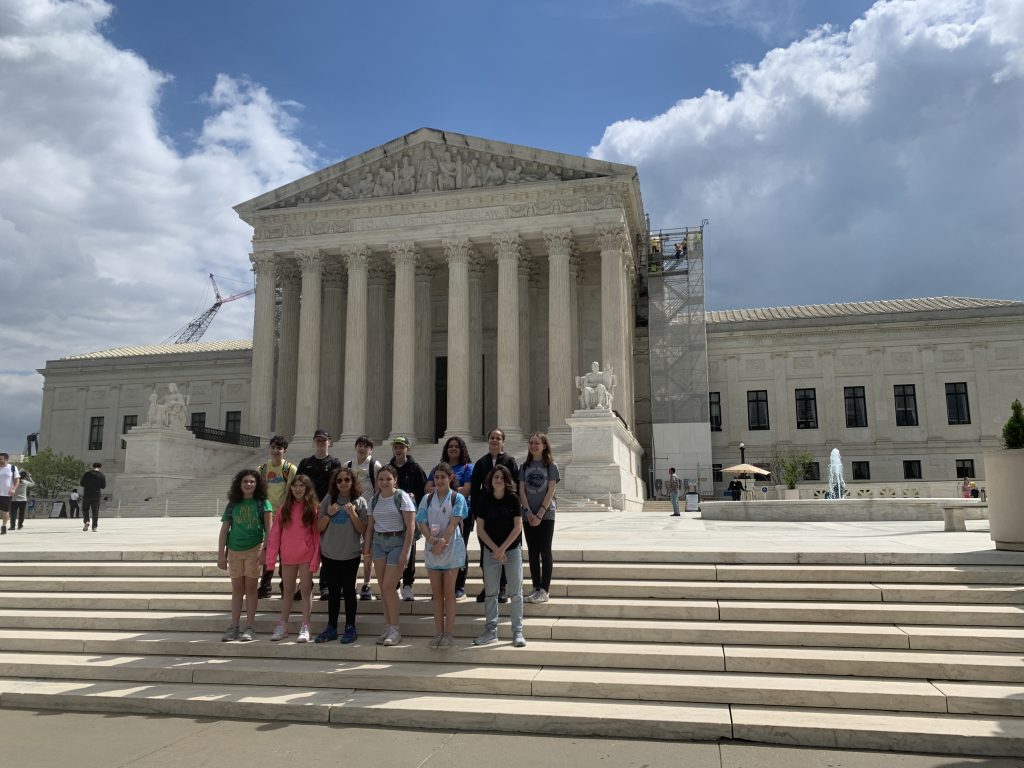
In seventh grade social studies, students study the events following The American Revolution through The Civil War. Students begin by analyzing the weaknesses of the Articles of Confederation and follow the progression to the framework of the United States Constitution. Students then learn about the events that led to westward movement and the expansion of the United States. Next, the students learn about the major causes of The Civil War and the events that led to the Union’s victory. A trip to Washington, D.C., in the spring brings this U.S. history to life with visits to Ford’s Theater, The Library of Congress, and more. Throughout each unit of study, students read and interpret maps and analyze primary and secondary sources.
Hebrew
Students learn more about Israeli culture and Hebrew vocabulary, reading comprehension, and grammar through the program B’shvil Ha’ivrit. Students in seventh grade Hebrew focus on being able to speak, write, and read using the present, past, and future tenses along with new prepositions and phrases. Students continue to improve their ability to express thoughts effectively in speech and in writing.
Jewish Studies
Torah: Students focus on historical events leading from the destruction of the Second Temple to the birth of the State of Israel. Major topics include: Jewish expulsion and major events in Europe, Asia, and Africa in the early twentieth century. They are introduced to famous biblical commentators and their interpretations and style.
Holidays: In seventh grade Jewish studies, students deepen their understanding of Jewish holidays and their historical, natural/agricultural, and faith-based foundation. They learn how our customs and traditions enrich and strengthen them as individuals within our Jewish community. Prayers and blessings related to the holidays are learned and Hebrew stories connected to the Jewish holidays are studied.
Israel: Students develop a meaningful relationship with Israel through personal connections with language, people, places, and events. As an ancient land and modern state, we teach our students that Israel is a home for diverse and vibrant expressions of Judaism. Our students engage with Israel at all grade levels and feel a deep connection to their homeland.
Prayer: Students experience community prayer twice a week with the school rabbi and rosh ruach (song leader). Music is used to enhance students’ spiritual experience connecting their hearts and minds. Students learn the keva (structure) of the Shacharit (morning prayer service) and explore pathways to deepen kavana (intentionality). Students also participate in a Torah service and discuss the weekly reading as well as other sacred texts.
The goal of our music program is for students to become skillful and enthusiastic music makers, encouraging music literacy, participation and performance. Through classical and contemporary music, students learn to sing in-tune with expression and confidence while gaining confidence on stage. Seventh grade students explore music composition using technology such as Garage Band.
Students work with a variety of drawing tools and multiple types of paints and papers in sophisticated ways. Students learn techniques for drawing, painting, printmaking, and collage. Within each grade level, elements of art such as line, shape, form, color, texture, value, and space are taught. Emphasis is put on the process of creating art rather than the finished product. Art history is an important component of our curriculum; students study different artists and art movements from the past to the present. Some movements that may be included are: Impressionism, Abstract, Folk, and Pop Art.
The annual EHS theater production is a vital and integral part of the upper school experience. All interested students in grades 5-8 participate either on stage, on backstage crew, or in other technical capacities. Play rehearsals take place throughout the school year in the after-school program setting and during elective times in school. The performances are in the spring at a community theater location. Through the school play process, students develop and refine numerous skills, including musical aptitude, public speaking, confidence building, teamwork, critical thinking, leadership, adaptability, and much more. Recent EHS musical productions have included Joseph and the Amazing Technicolor Dreamcoat; Fiddler on the Roof; Into the Woods, Jr.; and Frozen, Jr.
The theater program is generously sponsored in part by Sharon and Howard Rich through the Eunice and Sherman Seeche Cultural Arts Initiative.
Middle school students in physical education classes are encouraged to participate in sports education, teamwork, physical fitness activities, and sports strategy. In addition to gross and fine motor coordination, stretching, and agility, middle school students are taught age appropriate sports skills and team communication through drills as well as game-like scenarios. Units include flag rugby, handball, pickleball, volleyball, basketball, and floor hockey. Social team-building and sportsmanship skills are woven into games to teach students not only the skills to play multiple sports but the interpersonal skills to function in a fast-paced team environment.
For seventh grade students, the Library Teacher provides targeted direction as needed for classwork, including research and finding material for independent reading.